
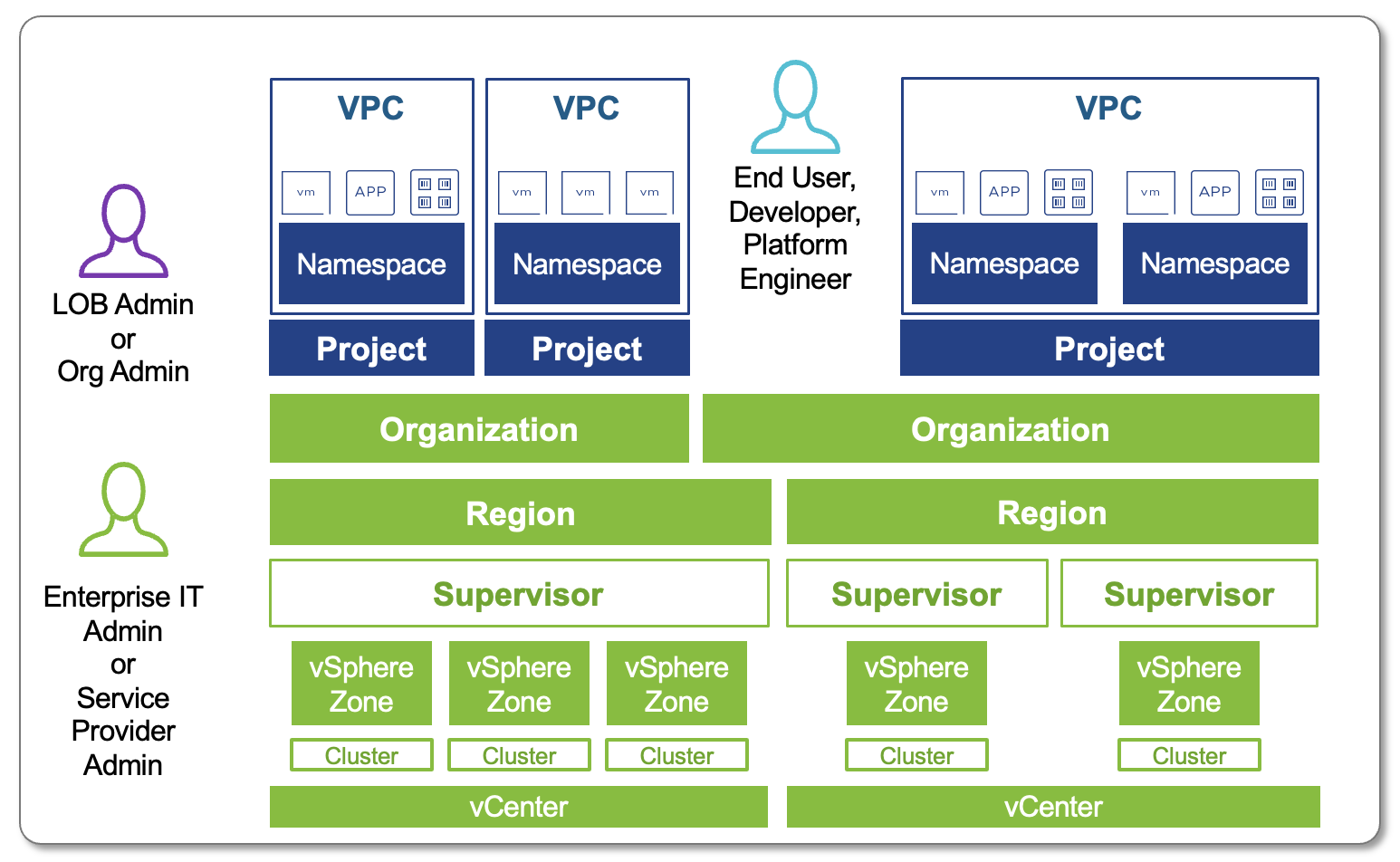
In today’s multi-tenant cloud environments, VMware Cloud Foundation Automation (VCFA) offers a robust layered architecture that seamlessly bridges enterprise-grade infrastructure management with developer-ready self-service capabilities.
By clearly separating responsibilities—from VMware Cloud Service Providers who manage the physical and virtual infrastructure, to organization administrators who allocate resources, and finally to developers who consume them—VCFA enables efficient resource governance, operational consistency, and scalability. This structured approach not only supports multi-tenancy and workload isolation but also accelerates innovation by empowering end users to deploy applications and services quickly within well-defined boundaries.
Why Tenant Management Matters?
Tenant management is more than just dividing resources—it’s about ensuring cost efficiency, security, scalability, and compliance in a shared infrastructure. In VCFA, these capabilities allow VMware Cloud Service Providers to maximize utilization without compromising performance or governance for individual tenants.

Key concepts to understand from both the Provider and Tenant perspectives:
Projects
Projects control user access to namespaces and user ownership of provisioned resources. All organizations are created with a default project. The default project is empty and does not have any namespaces or users.

Example: A VMware Cloud Service Provider might assign a dedicated project to each customer department for clearer billing and isolation.
Regions
The Regions page lists all the regions where the organization has a quota in. Organizations can have a quota in one or many regions. Your provider administrator assigns the regional quota to your organization. Quota in a region can come from one or many vSphere Zones within that region.

Example: A global enterprise hosted by a VMware Cloud Service Provider might have quotas in Asia and Europe to ensure low-latency access for local teams.
Namespace Class
Namespace classes are templates for namespace provisioning. These templates can be used to standardize namespace attributes, like utilization limits, reservations, VM classes, storage classes, and content libraries. organizations comes preconfigured with three default namespace classes (small, medium, and large), which are meant to serve as example templates. The only different attributes among these built-in templates are the CPU and Memory limits. Administrators can use these templates as-is or can modify them to suit their needs.

Namespace
Projects are the central construct for organizing and allocating infrastructure resources to tenants or teams. As the organization administrator, you manage and distribute infrastructure by assigning namespaces to projects. When configuring a project, you must add at least one namespace so that users within the project can begin provisioning workloads such as virtual machines, VMware Kubernetes Service (VKS) clusters, or other supported resources. Namespaces act as scoped resource pools, defining limits for CPU, memory, and storage to ensure fair allocation and performance consistency. Each namespace is tied to a Virtual Private Cloud (VPC) and a namespace class, which in turn is associated with at least one zone to determine placement and availability. This structure not only enforces resource governance but also enables automation workflows to deploy consistently within predefined boundaries. All organizations are created with a default project, which is initially empty and contains no namespaces or users, providing a baseline starting point for configuration.

Example: A tenant of a VMware Cloud Service Provider might create separate namespaces for development and production to avoid accidental resource conflicts.
Virtual Private Clouds (VPCs)
A Virtual Private Cloud (VPC) in VMware Cloud Foundation Automation (VCFA) offers an isolated networking environment that can be associated with one or more namespaces. Organizations can create multiple VPCs and assign each to specific namespaces based on workload or isolation requirements.
Each VPC is an independent network and supports three types of IP address spaces, each offering different levels of reachability:
- Private CIDRs: These addresses are internal to the VPC and are not routable outside without NAT. They are managed by the VPC administrator and do not need to be globally unique, allowing reuse across multiple VPCs.
- TGW Private IP Blocks: These IP blocks are scoped at the organization level and are advertised through the Transit Gateway (TGW) within the organization. Organization admins define these blocks, and project admins can allocate subnets from them for their VPCs. This enables direct communication between VPCs in the same organization using the TGW Private IP space.
- External IP Blocks: Managed by the provider admin, these IPs enable outbound access through Source NAT. Organization admins can assign subnets from provider-defined external blocks, giving workloads external connectivity while still using internal addressing.
You can choose to deploy a separate VPC per namespace for stricter isolation, or share a VPC across namespaces where network separation is not required.


Transit Gateways
Each organization has a transit gateway which provides connectivity to the provider gateway within the organization. One or more VPCs are connected to the transit gateway, and that connection is defined by a VPC connectivity profile. Each VPC has connected workloads and a private subnet. SNAT rules translate addresses from this private subnet to a public address in the IP spaces block. This infrastructure enables the organization and its workloads to connect to external networks.

You can view what transit gateways are available to your organization on the Manage & Govern > Networking > Transit Gateways page.

IP Management
Provider can use IP Spaces to manage their IP address allocation needs. IP Spaces provide a structured approach to allocating public IP addresses to different organizations, enabling connectivity to external networks.
An IP space consists of a set of CIDR blocks that are reserved, these CIDRs must be dedicated to and used by organization administrators as they configure services. An IP space can only be IPv4.
Organization administrators can create and manage the private IP blocks within their organization. there tenant can view external IP address blocks assigned to this organization by a provider. You can also create and view private TGW IP address blocks for the entire organization to use. Finally, you can view private VPC IP address blocks that are applicable to specific VPCs.

In essence, VMware Cloud Foundation Automation’s tenant management capabilities provide a structured, role-based framework for organizing projects, namespaces, VPCs, transit gateways, and IP resources. By aligning provider and tenant responsibilities, VMware Cloud Service Providers ensure secure isolation, consistent governance, and streamlined automation—empowering organizations to scale efficiently while maintaining full control over infrastructure and networking resources.
Leave a Reply