Month: February 2025

  • From Virtualization to Cloud Service Delivery with VMware Cloud Foundation & VCSPs

    From Virtualization to Cloud Service Delivery with VMware Cloud Foundation & VCSPs

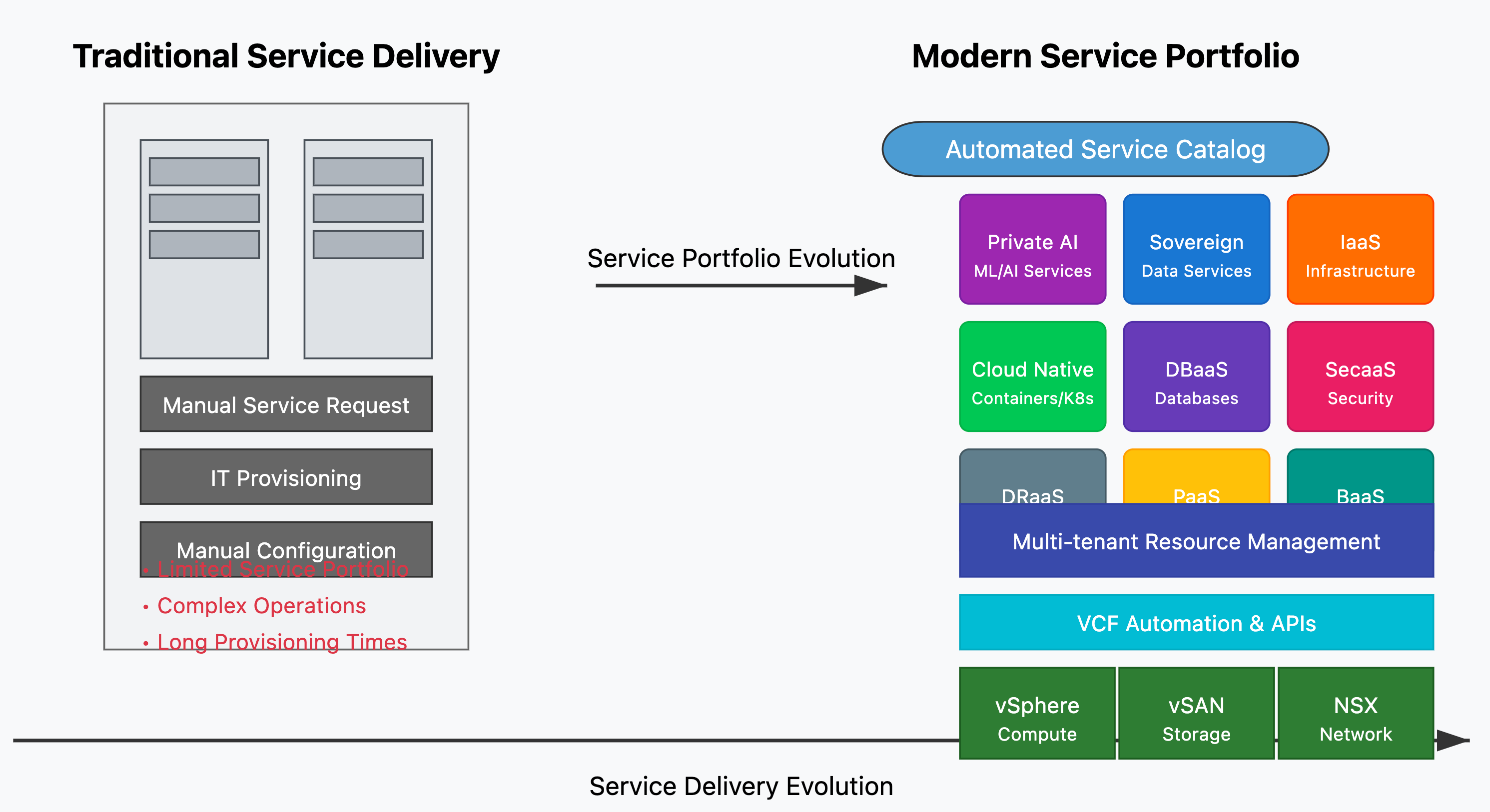
    The IT landscape is undergoing a massive transformation. Traditional virtualization, which once revolutionized data centers, is now evolving into full-fledged cloud service delivery. Organizations are no longer just managing VMs; they are delivering scalable, secure, and AI-ready cloud platforms.

    The Shift from Virtualization to Cloud Services

    Virtualization has been the backbone of IT infrastructure for over a decade, enabling efficiency, consolidation, and improved resource utilization. However, as digital transformation accelerates, enterprises require more than just virtual machines. They need scalable, automated, and AI-powered cloud platforms that can meet the growing demands of modern workloads.

    This shift is being powered by VMware Cloud Foundation (VCF)—the cornerstone of modern cloud infrastructure. With VCF, enterprises and Cloud Service Providers (CSPs) can move beyond virtualization to build multi-cloud, hybrid, and sovereign cloud environments with automation, security, and AI-driven capabilities at their core.

    Key Benefits of VMware Cloud Foundation

    Unified Platform: Compute, storage, networking, and management are integrated into a single solution.
    Hybrid & Multi-Cloud Operations: Seamlessly run workloads across private, public, and hybrid cloud environments.
    Built-in Security & Compliance: Ensure data sovereignty and regulatory compliance with sovereign cloud initiatives.
    AI-Ready Infrastructure: GPU acceleration and private AI capabilities empower AI/ML workloads.
    Accelerated Cloud Service Delivery: Enable Cloud Providers & VMware Cloud Service Providers (VCSPs) to deliver next-gen cloud offerings.

    The Significance of VMware Cloud Providers (VCSPs)

    VMware Cloud Providers (VCSPs) play a pivotal role in enabling organizations to seamlessly transition from virtualization to cloud services. They extend the capabilities of VMware Cloud Foundation by offering:

    🔹 Managed Cloud Services: Helping enterprises offload infrastructure management with fully managed VMware-based cloud environments.
    🔹 Sovereign and In-Country Cloud Solutions: Ensuring compliance with regional data sovereignty laws while delivering cloud scalability.
    🔹 Multi-Tenant Cloud Platforms: Empowering service providers to offer flexible, cost-effective cloud solutions with secure tenant isolation.
    🔹 AI and GPU-Powered Cloud Services: Providing enterprises with AI-ready infrastructure to support next-gen workloads.
    🔹 Disaster Recovery & Business Continuity: Offering reliable DRaaS (Disaster Recovery as a Service) to ensure business resilience.

    Future of Cloud with VMware Cloud Foudation

    As enterprises and service providers embrace cloud-first and AI-driven strategies, VCF is enabling them to deliver next-generation cloud services with agility, resilience, and efficiency. This evolution is not just about technology; it’s about unlocking new business opportunities, enhancing innovation, and driving digital transformation at scale.

    With cloud-native applications, AI/ML workloads, and security-first cloud strategies becoming the new normal, the role of VMware Cloud Foundation is more critical than ever.

    VMware Cloud Foundation is transforming the way cloud services are delivered, from the traditional virtualization model to highly flexible, customer-tailored cloud services. With the support of VCSPs, businesses are empowered to adopt cutting-edge cloud solutions faster and more efficiently than ever before.

  • Enhancing Firewall Flexibility in VMware Cloud Director 10.6.1

    With VMware Cloud Director 10.6.1, service providers gain greater flexibility and control over firewall configurations, ensuring compliance with licensing entitlements while delivering scalable, high-value security services. This update aligns with VMware Cloud Foundation (VCF) networking licensing, enabling providers to selectively offer the VMware Advanced Networking & Security (ANS) Add-On to customers based on their needs and cost agreements.

    Impact of VMware NSX Licensing Changes

    Recent changes to VMware’s NSX licensing model have significantly altered how firewall features are provisioned. Under the new structure:

    • Stateless Firewall is included in the VMware Cloud Foundation (VCF)
    • Stateful Firewall now requires an additional, separate license documented Here

    This change impacts how service providers manage network security within VMware Cloud Director environments. To address these shifts, Cloud Director 10.6.1 introduces new controls that give providers flexibility in defining which firewall type—stateless or stateful—is available to their tenants. This ensures security policies align with business needs while optimizing costs associated with VMware licensing.

    VMware Cloud Director with NSX supports both stateful and stateless firewalls, each serving different security needs:

    What is a Stateless Firewall?

    A stateless firewall inspects traffic on a per-packet basis without maintaining the state of active connections. Unlike stateful firewalls, which track the context of traffic flow, stateless firewalls apply predefined rules to each packet independently.

    💡 Key Benefits:
    ✔ Faster packet processing for high-performance workloads.
    ✔ Ideal for perimeter protection and edge security use cases.
    ✔ Lower resource consumption compared to stateful firewalls.

    Stateful vs. Stateless Firewalls in Cloud Director

    FeatureStateful FirewallStateless Firewall
    Connection Tracking✅ Maintains connection state❌ No connection awareness
    Security Context✅ Applies rules based on traffic flow❌ Evaluates each packet independently
    PerformanceHigher resource usageLightweight, optimized for speed

    Configuring in Cloud Director

    This feature is designed to help cloud service providers who wish to control which tenants can access Stateless/Stateful Firewall services. The goal is to enforce better governance over the consumption of advanced network services, such as Stateful Firewall and Distributed Firewall.

    The license selection is made at the Edge Cluster level in VCD. The service provider determines which type of firewall can be applied to a specific Edge Cluster. Consequently, all Provider/Organization and vApp Edge Gateways utilizing that cluster will have firewall rules configured as either stateful or stateless, depending on the selection.

    This will have corresponding changes in NSX, while The firewall rule configuration remains the same in vCD. below is the VMware Cloud Director (VCD) view of the Org VDC Edge Gateway firewall configuration deployed on an Edge Cluster designated with the stateless firewall option inside NSX Manager.

    NOTE : Changing an Edge Cluster from Stateful to Stateless or vice versa will not impact existing deployed Gateways.

    Gateway Firewall Enforcement Control in VCD

    One key use case is when a service provider or tenant is using an appliance-based third-party firewall instead of the NSX-integrated firewall in Cloud Director. In such cases, they may not require NSX-based firewall enforcement and prefer to manage security through their own solution. This feature allows them to disable the NSX firewall, ensuring flexibility in security architecture without unnecessary conflicts.

    Now with this release both service providers and tenants can disable or enable the firewall at the Provider or Org Gateway level without removing existing firewall rules. A new “Active” switch has been introduced in the Firewall UI (top right corner), allowing users to toggle firewall enforcement as needed while preserving the configured rules.

    Conclusion

    The new firewall flexibility in Cloud Director 10.6.1 ensures that service providers can:

    Optimize licensing costs by choosing stateless or stateful firewall options.
    Align security offerings with customer needs.
    Enhance governance and compliance around advanced network security services.
    Seamlessly integrate third-party firewall solutions into their cloud environments.

    By leveraging these new capabilities, Cloud Director providers can deliver scalable, efficient, and cost-effective security solutions while adapting to the evolving VMware NSX licensing model.

    Cloud Director 10.6.1 Release Notes Published Here