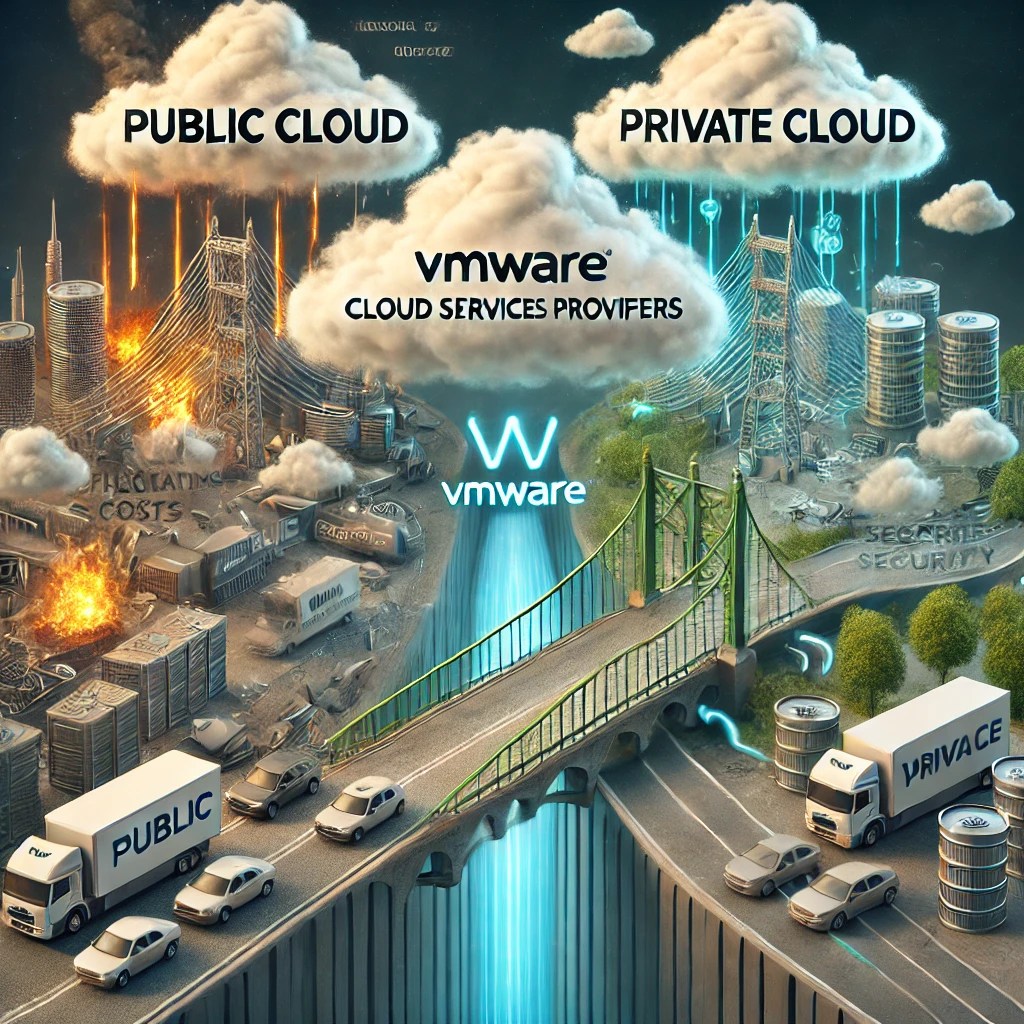
As businesses’ cloud strategies evolve, many are reconsidering their reliance on public cloud environments and exploring the benefits of private cloud solutions. Public clouds like AWS, Azure, and Google Cloud offer flexibility and scalability, but they also come with challenges such as unpredictable costs, security concerns, and limited control. This is where VMware Cloud Service Providers (CSPs), powered by VMware Cloud Foundation (VCF), present a compelling alternative for businesses looking to transition from public to private cloud. Here’s why customers should choose a VMware CSP when making this move:
1. Predictable Costs and Better Financial Control
Public Cloud Challenge:
The pay-as-you-go model of public clouds is attractive at first but often leads to unpredictable and escalating costs. Usage spikes, data transfer fees, and networking costs can cause budget overruns, making it difficult for businesses to manage long-term financial planning.
VMware CSP Advantage:
With VMware Cloud Foundation hosted by a VMware CSP, costs become more predictable and fixed. Unlike public clouds, where charges can fluctuate based on consumption, VMware CSPs offer stable pricing tailored to the customer’s dedicated infrastructure needs. This leads to greater financial control and ensures that businesses can plan their budgets with confidence, avoiding unexpected bills and cost surges.
2. Enhanced Security and Compliance
Public Cloud Challenge:
While public cloud providers maintain infrastructure security, customers are responsible for securing their data. This shared responsibility model introduces potential security gaps, especially in multi-tenant environments where data is more exposed. For industries with strict regulatory requirements, such as healthcare and finance, managing compliance in a public cloud can be challenging.
VMware CSP Advantage:
VMware Cloud Service Providers offer private, dedicated infrastructure, giving businesses full control over their security protocols. VMware Cloud Foundation includes built-in features like NSX micro-segmentation, end-to-end encryption, and automated compliance controls to ensure robust security. This infrastructure meets the stringent security needs of industries like government and financial services, making it easier for organizations to comply with regulations such as GDPR, HIPAA, and PCI-DSS.
By choosing a VMware CSP, businesses can deploy their own security policies and governance measures, ensuring full compliance without the risks associated with public cloud environments.
3. Consistent Performance and Infrastructure Customization
Public Cloud Challenge:
Public clouds are designed to serve a broad range of customers, leading to performance variability. The shared, multi-tenant nature of public clouds can cause resource contention, which negatively impacts performance for businesses with mission-critical workloads. Additionally, public cloud platforms offer limited options for customizing infrastructure to optimize specific workloads.
VMware CSP Advantage:
With a VMware CSP, businesses gain access to dedicated infrastructure that provides consistent, reliable performance. VMware Cloud Foundation allows companies to customize their private cloud environments, tuning resources to meet the exact demands of high-performance workloads like AI/ML, enterprise applications, or data-intensive tasks. This ensures optimal performance and avoids the unpredictable resource contention seen in public cloud environments.
4. Full Control Over Data and Infrastructure
Public Cloud Challenge:
In a public cloud setup, businesses often lose a degree of control over their data and infrastructure, as public cloud providers manage the underlying systems. This can lead to vendor lock-in, where organizations are restricted to the cloud provider’s tools and architecture, making it difficult to adapt or migrate workloads.
VMware CSP Advantage:
VMware Cloud Foundation offers businesses full control over their infrastructure, ensuring flexibility and freedom. With a VMware CSP, organizations are not bound by the limitations of a public cloud vendor’s ecosystem. Instead, they can manage and operate their private cloud environment according to their own policies and tools, retaining ownership of their data and ensuring it is managed and stored in compliance with their internal standards.
Moreover, VMware CSPs provide a vendor-neutral platform, reducing the risk of cloud lock-in and enabling smoother transitions to other cloud models if needed.
5. Simplified Compliance and Data Residency
Public Cloud Challenge:
Many businesses must comply with strict regulations around data residency and sovereignty, requiring data to be stored and processed within specific regions. While public clouds offer region-based services, maintaining compliance can be complex due to the global nature of their infrastructure and multi-tenant environments.
VMware CSP Advantage:
VMware Cloud Service Providers offer private cloud environments where data residency is easily enforced, ensuring that sensitive information remains within required geographic boundaries. Organizations can select specific data center locations that comply with local laws and regulatory requirements, providing greater control over data governance. This is crucial for industries like finance, healthcare, and government, where compliance and data sovereignty are paramount.
6. Hybrid and Multi-Cloud Flexibility
Public Cloud Challenge:
Public clouds are optimized for running workloads within their own ecosystem, making hybrid or multi-cloud strategies more complex. This often results in vendor lock-in, where businesses are limited to the services and infrastructure of a single cloud provider.
VMware CSP Advantage:
VMware Cloud Foundation is designed for hybrid and multi-cloud environments, offering businesses the flexibility to run workloads across private clouds, on-premises infrastructure, and public clouds (via VMware Cloud on AWS, Azure VMware Solution, or Google Cloud VMware Engine). This allows businesses to choose the best environment for each workload while maintaining a consistent management experience across clouds. VMware CSPs provide the best of both worlds, enabling seamless hybrid cloud operations without sacrificing control or flexibility.
7. Long-Term Cost Efficiency and Lower Total Cost of Ownership (TCO)
Public Cloud Challenge:
Public clouds are ideal for elastic workloads but can become costly for steady-state or predictable workloads. Over time, businesses may find that public cloud environments become less efficient, with resources underutilized or costs outpacing usage.
VMware CSP Advantage:
Private clouds hosted by VMware CSPs offer a more cost-efficient solution for businesses with predictable workloads. By shifting to a fixed-cost private cloud model, organizations avoid the long-term costs of over-provisioning in the public cloud. VMware Cloud Foundation optimizes resource utilization, ensuring infrastructure is used efficiently, leading to a lower total cost of ownership (TCO) over time.
For enterprises looking to stabilize their operational costs while maintaining cloud-level flexibility, VMware CSPs provide a long-term financial advantage compared to public cloud platforms.
Conclusion
Transitioning from public cloud to a private cloud environment hosted by a VMware Cloud Service Provider offers businesses a powerful combination of predictable costs, enhanced security, control, and customized infrastructure. VMware CSPs allow organizations to regain control over their data and operations, ensure compliance with stringent regulatory requirements, and optimize performance for mission-critical applications.
For enterprises seeking a strategic balance between cloud agility and operational control, VMware Cloud Service Providers are the ideal partners to support a seamless and effective move from public cloud to private cloud.

 VMTECHIE
Leave a comment